 View Source
A compiled systems language built from scratch in C, structured as a monorepo with a dedicated compiler, CLI, and standard library. Focused on tight architecture, minimal dependencies, and no unnecessary abstraction — full pipeline from lexer through LLVM IR codegen, with a hand-rolled semantic analysis layer and structured error codes.
 1  fn main()
 2  {
 3    let a: str = core_io::input("First Num: ");
 4    let op: str = core_io::input("Operation: ");
 5    let b: str = core_io::input("Second Num: ");
 6
 7    if (op == "+") { return a + b; }
 8    else if (op == "-") { return a - b; }
 9    else if (op == "*") { return a * b; }
10    else if (op == "/") { return a / b; }
11    else
12    {
13      core_io::println("Input a real operator")
14    }
15  }
rigg/examples/calc   main  ~
❯  rigg check
Error S001: expected ';' but got '}'
--> main.fn:13

Error F001: Missing primary function in 'main.fn'
--> main.fn
  (Note: Parse errors may have prevented extraction.)
rigg: build failed

rigg/examples/calc   main  ~
❯  ▋
# stdlib modules
core_io
core_str

# entry targets
main:
  -> core_io
  -> core_str
[project]
name    = "calc"
version = "0.1.0"
author  = ""

[build]
opt     = 3
View Source
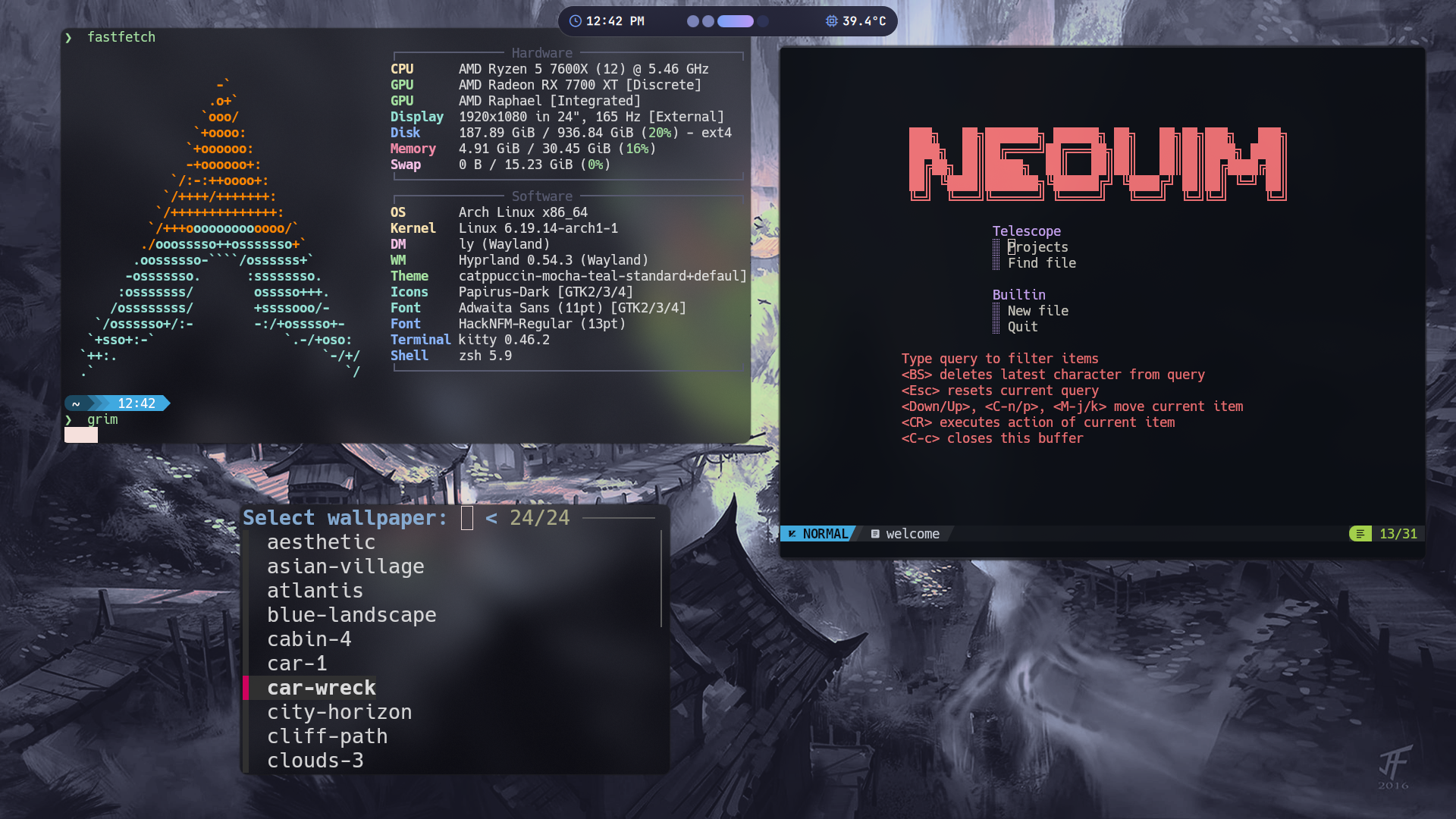
A meticulously crafted Linux environment featuring a custom Hyprland window manager configuration. This setup focuses on a highly productive workflow, minimal system overhead, and deep system tuning. It includes optimized Wayland performance, and a unified aesthetic across all system components and development tools.
 View Source
A simple, terminal-based text editor written in C, using a rope data structure for efficient text manipulation. It features a clean interface, basic editing capabilities, and is designed for speed and minimal resource usage. Inspired by nano, it serves as a personal project to explore low-level programming and data structures.
This project was a deep dive into C programming, memory management, and data structures. Implementing a rope allowed me to efficiently handle large texts without the overhead of contiguous memory. It also provided valuable experience in building a user interface in the terminal and managing input/output operations at a low level.
View Source
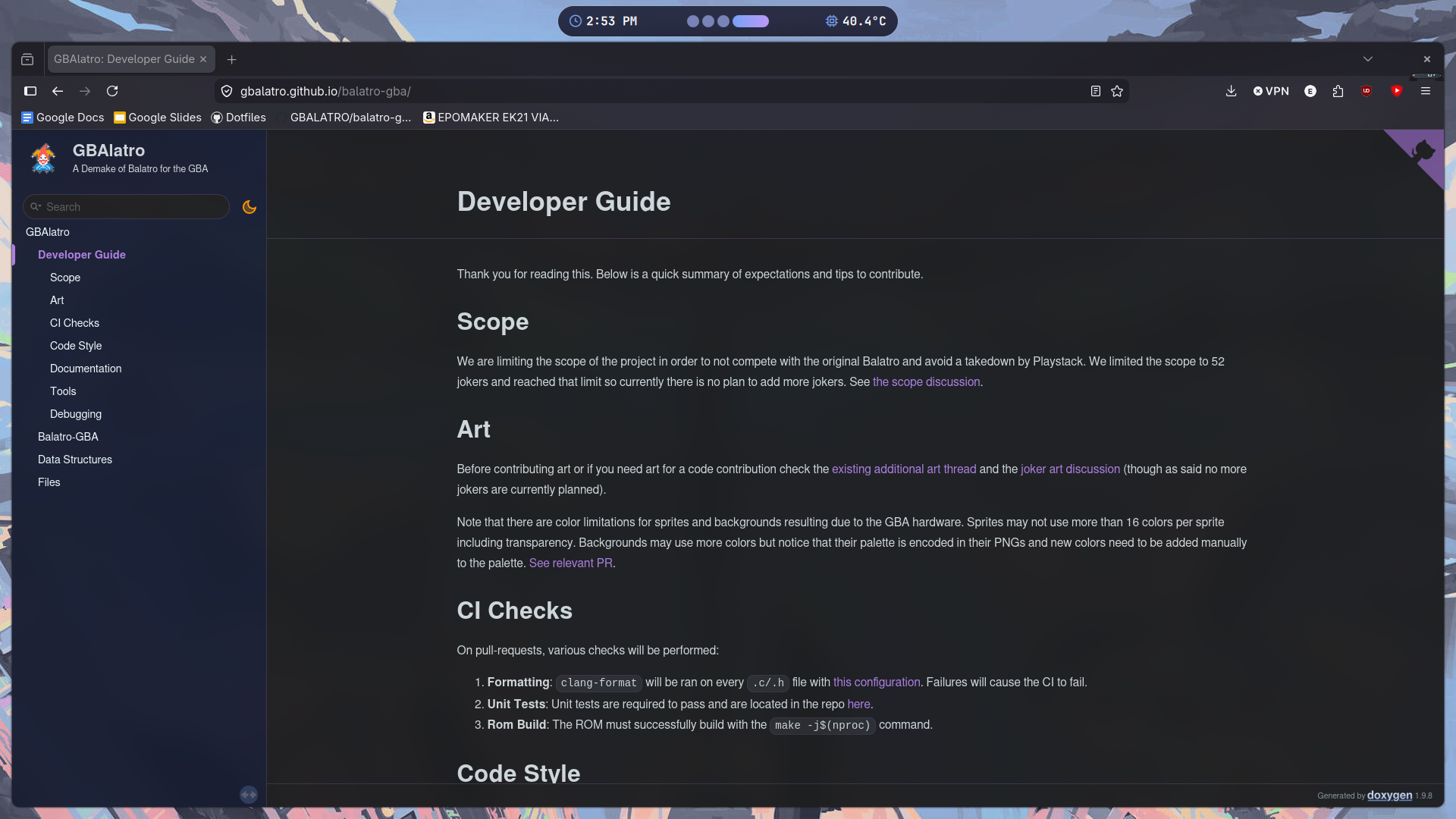
Architected a robust CI/CD workflow to automate the generation and deployment of Doxygen technical documentation, ensuring real-time synchronization between the codebase and public-facing references.
Integrated Doxygen Awesome to enhance documentation accessibility, customizing the visual layer to align with the project's aesthetic while maintaining high information density for developers.
Optimized animation damping algorithms by substituting expensive floating-point division with bitwise right-shift operations, significantly reducing per-frame CPU cycle consumption on the GBA's ARM7TDMI architecture.